

Your Browsing History





Any questions? Our AI beta will help you find out quickly.
WiFi, also known as Wi-Fi, is ubiquitous nowadays from computers and smartwatches to smartphones and tablets. However, not all wireless networks are the same. The various Wi-Fi standards, ranging from Wi-Fi n and ac to the latest developments such as Wi-Fi 6 (802.11ax) and Wi-Fi 6E, can be confusing. Here, we provide a comprehensive guide to understanding everything about Wi-Fi, especially the 802.11ac WiFi antennas.
Regarding Wi-Fi 6 (802.11ax) and the extension Wi-Fi 6E, these standards provide increased capacity and efficiency, especially in environments with many devices. Wi-Fi 6E extends the frequency bands to the 6 GHz range, allowing additional channels to minimize interference.
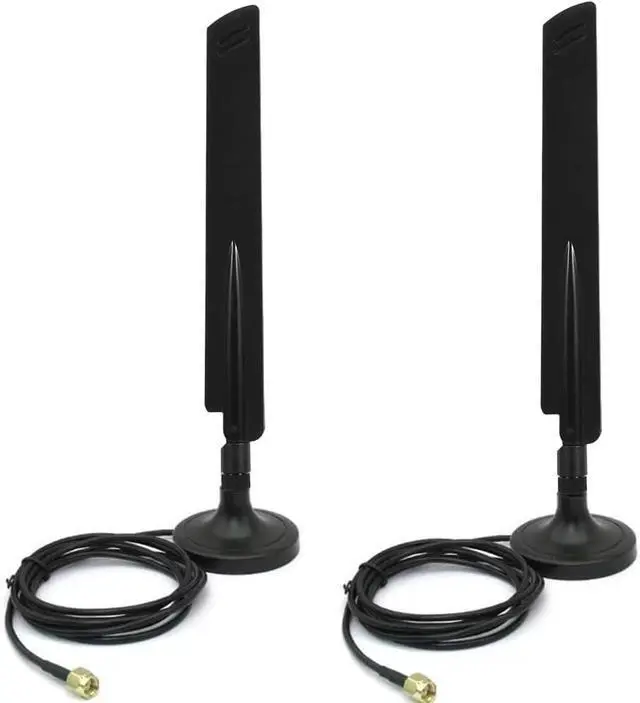
The benefits of Wi-Fi AC (802.11ac) includeDirectional and omnidirectional antennas compatible with the 802.11ac/ax and WiFi 6E standards. The ac/ax standards enable extremely high bandwidths. We offer different types of antennas with varying ranges for various deployment scenarios. We are happy to assist you in selecting the right 802.11ac/ax WiFi antenna. 802.11ac (WiFi 5): The 802.11ac standard, also known as WiFi 5, primarily operates in the 5 GHz band and provides higher bandwidth compared to its predecessors (802.11a/b/g/n). 802.11ac supports MIMO, improving data transmission by utilizing multiple antennas, and contributing to better performance in environments with many wireless devices. 802.11ax (WiFi 6): The 802.11ax standard, also known as WiFi 6, also operates mainly in the 5 GHz band and offers higher theoretical data transfer rates compared to WiFi 5 (802.11ac). This allows for even faster wireless connections and improved performance, especially in environments with many concurrently connected devices. WiFi 6E (E=Extended): Wi-Fi 6E extends the available frequency range of the 802.11ax standard to the 6 GHz band (5925 - 7125 MHz), resulting in more available channels and further increasing bandwidth.
The introduction of Wi-Fi 6 (802.11ax) brings additional improvements in efficiency, speed, and capacity. Multi-user MIMO (MU-MIMO) allows access points to effectively communicate with multiple devices simultaneously.
WiGig (802.11ad) specializes in extremely high speed over short distances and is mainly used for wireless docking stations in enterprises.
Interoperability issues may arise, especially with different frequency bands. However, most routers are dual-band, allowing the use of various Wi-Fi standards. Backward compatibility exists as long as devices operate on the same frequency band.
In practice, throughput is halved compared to theoretical speed, and the 2.4 GHz band may be congested in urban areas. For more demanding applications such as HD video streaming, 5 GHz WiFi is often recommended. When choosing WiFi for smartphones, tablets, and laptops, considering the supported antennas and streams is important to achieve maximum speed.